




Why Do You Feel Different During Certain Moon Phases?
Need Guidance On Your Problems?
Consult With The Best Online Psychics


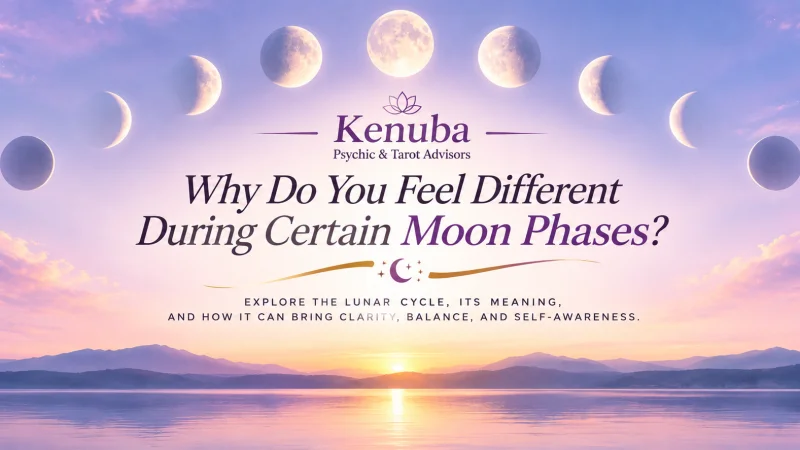
Why Do You Feel Different During Certain Moon Phases?
Have you ever noticed that some nights make you feel more reflective, while other days seem to bring a desire for change, fresh beginnings, or emotional clarity? Perhaps you enjoy setting new intentions around the new moon, feel drawn to complete unfinished things before the full moon, or simply find yourself paying more attention to your emotions during certain parts of the lunar cycle.
The Moon has fascinated people for centuries. Its changing appearance has inspired stories, spiritual traditions, astrology, rituals, and personal reflection. Even today, many people use moon phases as a way to understand their feelings, review their goals, and create meaningful routines.
But why do you feel different during certain moon phases? Is there a connection between the Moon and your emotions, or is it more about the meaning you personally associate with different stages of the lunar cycle?
In this guide, we will explore the eight moon phases, their traditional spiritual and astrological associations, how people use them for self-reflection, and how tarot can help you explore your personal experiences.
1. Why Do Moon Phases Feel So Meaningful?
The Moon changes its appearance throughout the month because of its position relative to Earth and the Sun. As it travels around Earth, we see different portions of its sunlit side. A complete cycle from one new moon to the next takes approximately 29.5 days.
There are eight commonly recognized phases: new moon, waxing crescent, first quarter, waxing gibbous, full moon, waning gibbous, third quarter, and waning crescent.
Beyond the astronomy, different cultures and spiritual traditions have attached symbolic meanings to these phases.
In astrology and modern spiritual practices, the lunar cycle is often used as a symbolic framework for understanding personal experiences:
-
New moon: Fresh beginnings and setting intentions.
-
Waxing moon: Growth, motivation, and taking action.
-
Full moon: Awareness, emotional reflection, and completion.
-
Waning moon: Releasing, reviewing, and letting go.
These associations can give you a regular opportunity to pause and think about what is happening in your life.
It is important to understand that science has not established that each moon phase directly causes a particular emotion. Your feelings can also be influenced by sleep, stress, relationships, daily experiences, and many other factors.
You can still find personal meaning in the lunar cycle without assuming that the Moon controls your emotions.
2. How Each Moon Phase Is Traditionally Associated With Your Emotions
Each lunar phase carries a different symbolic meaning in astrology and spiritual practices. Understanding these associations can help you use the lunar cycle as a personal reflection tool.
New Moon – A Time for Fresh Beginnings
The new moon occurs when the side of the Moon facing Earth appears dark. It marks the beginning of a new lunar cycle.
In spiritual traditions, the new moon is often associated with fresh starts, intentions, and possibilities.
You may use this phase to think about what you want to change, what goals matter to you, and what kind of experiences you want to create.
Ask yourself:
-
What would I like to begin?
-
Which personal goal deserves more attention?
-
What habit would I like to develop?
-
What do I want to experience differently this month?
A simple intention-setting practice can help you turn these thoughts into realistic goals.
Waxing Crescent – Building Confidence and Motivation
During the waxing crescent phase, a small illuminated portion of the Moon becomes visible and gradually grows.
Symbolically, this phase is associated with hope, early progress, and building momentum.
It can be a useful time to review the intentions you made during the new moon and identify small actions that support them.
For example, if you want to improve your career, you could update your CV, learn a new skill, or research opportunities.
The message of this phase is simple: meaningful progress often begins with small steps.
First Quarter – Facing Decisions and Challenges
During the first quarter, approximately half of the Moon's visible face appears illuminated.
In lunar symbolism, this phase is often connected with decisions, action, and overcoming obstacles.
You may use it to reflect on the challenges that have appeared since setting your intentions.
Ask yourself:
-
What is stopping me from moving forward?
-
Which decision am I avoiding?
-
What needs more attention?
-
Am I taking practical steps toward my goals?
Rather than waiting for everything to become easy, consider what you can do with the resources available to you.
Waxing Gibbous – Refining Your Plans
The waxing gibbous phase occurs as the illuminated portion of the Moon grows toward fullness.
Traditionally, it is associated with preparation, patience, refinement, and continued effort.
This is a useful symbolic reminder to review your progress and improve your approach.
Perhaps your original plan needs adjustment. Maybe you have learned something important about your priorities, or you need to give yourself more time.
Instead of judging yourself for not reaching your goal immediately, consider what you can improve.
Full Moon – Awareness and Emotional Reflection
The full moon occurs when the Moon's visible face appears fully illuminated from Earth.
It has a special place in many spiritual traditions and is often associated with heightened awareness, emotional reflection, gratitude, and completion.
Some people use the full moon as an opportunity to review their experiences and recognize what has changed since the beginning of the lunar cycle.
You might reflect on questions such as:
-
What have I learned about myself recently?
-
Which situation needs my attention?
-
What progress should I acknowledge?
-
Which expectations are no longer helping me?
The full moon does not automatically create emotional intensity or difficult experiences. However, its symbolic meaning can provide a helpful reason to pause and examine your feelings.
Waning Gibbous – Gratitude and Understanding
After the full moon, the visible illuminated portion begins to decrease.
In spiritual practices, the waning gibbous phase is often associated with gratitude, sharing lessons, and understanding personal experiences.
You can use this period to recognize what went well, appreciate the support you received, and think about what you learned.
Ask yourself:
-
What am I grateful for?
-
Which experience taught me something valuable?
-
What progress should I recognize?
-
How can I use what I have learned?
This phase encourages you to acknowledge progress instead of focusing only on what remains unfinished.
Third Quarter – Releasing What No Longer Helps
During the third quarter, half of the Moon's visible face appears illuminated again, but the opposite side from the first quarter.
Symbolically, this phase is often connected with reassessment, releasing old patterns, and making space for change.
You might use it to consider habits, expectations, or responsibilities that no longer support your well-being.
For example, perhaps you are spending too much time comparing yourself with others, holding on to an unhealthy routine, or avoiding a conversation that needs attention.
Ask yourself what you can change to create a healthier balance.
Waning Crescent – Rest and Inner Reflection
The waning crescent is the final visible stage before the next new moon.
It is traditionally associated with rest, quiet reflection, closure, and preparation for another cycle.
You can use this phase to slow down, review your experiences, and think about what you want to carry into the next month.
You do not need to fill every moment with activity. Sometimes, giving yourself space to rest and reflect is a meaningful step forward.
3. Does the Full Moon Really Affect Your Mood?
Many people report feeling different around the full moon. Some describe feeling more emotional, energetic, restless, or reflective.
But does the full moon actually change human emotions?
The scientific evidence is mixed and limited. Some studies have explored possible relationships between lunar phases and sleep. For example, a 2013 study published in Current Biology reported changes in certain sleep measures around the full moon under controlled laboratory conditions. Other research has reported associations between lunar timing and sleep duration, but findings do not establish that the full moon directly changes everyone's mood or emotional state.
This distinction matters because sleep and mood can influence each other. If your sleep is disrupted, you may notice changes in your energy, patience, or concentration.
It is also possible that expectations and cultural beliefs influence how people interpret their experiences.
Rather than assuming every emotional change is caused by the Moon, consider keeping a personal journal. Record your sleep, mood, stress, daily activities, and the current moon phase over several weeks.
This can help you notice your own patterns without assuming that every feeling has the same explanation.
4. How Astrology Interprets Moon Phases
In astrology, the Moon is traditionally associated with emotions, instincts, comfort, and inner needs.
Astrologers often consider the Moon's zodiac sign, its phase, and its relationship with other planets when interpreting a birth chart or a particular period.
Here are a few common concepts.
Your Natal Moon Sign
Your Moon sign is determined by the Moon's position in the zodiac at the time of your birth.
In astrology, it is often used to explore emotional preferences, comfort, instinctive reactions, and personal needs.
For example, astrologers traditionally associate:
-
Moon in Cancer with emotional security and nurturing.
-
Moon in Aries with independence and direct emotional expression.
-
Moon in Taurus with comfort, stability, and consistency.
-
Moon in Gemini with curiosity and communication.
-
Moon in Leo with warmth, recognition, and creative expression.
-
Moon in Virgo with practical support and organization.
-
Moon in Libra with harmony and connection.
-
Moon in Scorpio with emotional depth and intensity.
-
Moon in Sagittarius with freedom and exploration.
-
Moon in Capricorn with responsibility and structure.
-
Moon in Aquarius with independence and individuality.
-
Moon in Pisces with imagination and sensitivity.
These are traditional astrological interpretations, not scientifically established personality descriptions.
The Moon's Zodiac Sign Changes
The Moon moves through the zodiac relatively quickly, spending roughly two to three days in each sign.
Astrologers use these changing positions to interpret daily emotional themes and the general atmosphere of a particular period.
For example, a Taurus Moon is traditionally associated with stability and comfort, while a Gemini Moon is associated with communication and curiosity.
You can explore these interpretations as a way to think about your preferences and experiences, rather than treating them as fixed predictions.
New Moon and Full Moon in Astrology
Astrologically, a new moon occurs when the Sun and Moon meet in the same zodiac sign. It is traditionally associated with setting intentions and beginning a new cycle.
A full moon occurs when the Sun and Moon are opposite each other in the zodiac. It is often interpreted through themes of awareness, balance, and completion.
The specific zodiac signs involved are important to astrologers when interpreting the symbolic meaning of a particular new or full moon.
5. How Tarot Can Help You Reflect During Different Moon Phases
Tarot and moon rituals are often used together in modern spiritual practices.
While astrology can provide a symbolic framework for the lunar cycle, tarot can help you explore personal questions connected with each stage.
You do not need to draw cards every day. You can choose one reading at the beginning, middle, or end of a lunar cycle.
Here are some tarot cards and their traditional associations that may be useful for reflection.
The Fool – New Beginnings
The Fool is commonly associated with fresh starts, openness, exploration, and taking a first step.
During the new moon, you can use this card as a reminder to consider new opportunities and identify what you want to begin.
Ask yourself: What new experience am I ready to explore?
The Magician – Taking Action
The Magician represents personal resources, creativity, confidence, and initiative.
During the waxing phases, this card can encourage you to consider which skills and resources you can use to make progress.
Ask yourself: What can I do with the opportunities and abilities I already have?
The Chariot – Moving Through Challenges
The Chariot is associated with determination, direction, and self-discipline.
During the first quarter, it can be a useful symbol for reflecting on decisions and obstacles.
Ask yourself: Where do I need more focus and commitment?
The Sun – Awareness and Confidence
The Sun represents optimism, clarity, warmth, and confidence.
During the full moon, it can encourage you to recognize your achievements and appreciate the progress you have made.
Ask yourself: What positive changes have I noticed in myself?
The Hermit – Quiet Reflection
The Hermit represents introspection, inner wisdom, and taking time to understand yourself.
During the waning phases, this card can encourage you to step back and consider what you have learned.
Ask yourself: What do I need to understand before beginning another cycle?
Death – Transformation and Release
The Death card is traditionally associated with endings, transition, and transformation, rather than literal death.
It can be a useful symbol when reflecting on what you are ready to release.
Ask yourself: Which old pattern or expectation is no longer helping me?
6. A Simple Moon Phase Tarot Spread for Understanding Your Emotions
If you notice that your feelings change throughout the month, try this five-card tarot spread as a personal reflection exercise.
Before shuffling your cards, think about your current emotional state and the lunar phase you are experiencing.
Ask:
"What can I understand about my current feelings and the changes I am experiencing?"
Draw five cards and place them in the following positions.
Card 1: My Current Emotional State
What feelings or concerns are taking most of my attention right now?
Card 2: What Is Influencing My Feelings?
What experiences, expectations, or personal circumstances should I consider?
Card 3: What Am I Overlooking?
Is there another perspective or an important need that I have not recognized?
Card 4: What Should I Release or Develop?
Which habit, expectation, or personal quality deserves attention?
Card 5: My Next Step
What practical action can support my emotional well-being and personal growth?
After completing the spread, write down your interpretations. Consider how they relate to your everyday experiences.
Remember, the cards are symbolic prompts for reflection. They cannot diagnose emotional conditions or establish that the Moon is responsible for a particular feeling.
7. How to Create a Simple Moon Phase Self-Care Routine
You do not need expensive tools or complicated rituals to connect with the lunar cycle.
A simple routine can help you create regular moments for reflection and personal growth.
During the New Moon
Write down one or two realistic intentions for the coming month.
Choose something meaningful, such as improving communication, learning a skill, or developing a healthier routine.
During the Waxing Moon
Take small actions toward your intentions.
Review your progress and identify what you can improve.
During the Full Moon
Pause and reflect on your experiences.
Write down what you have learned, what you appreciate, and which situations need your attention.
During the Waning Moon
Review your habits and commitments.
Consider what is no longer useful and what you would like to approach differently in the next cycle.
Keep a Moon and Mood Journal
A journal can help you understand your own experiences more clearly.
You can record:
-
The current moon phase.
-
Your mood and energy.
-
Your sleep quality.
-
Important events or conversations.
-
Your stress levels.
-
Any personal reflections or tarot cards you draw.
After a few lunar cycles, review your notes and look for patterns.
This is more useful than assuming that every emotional experience is caused by a particular moon phase.
8. When Should You Explore a Moon Reading With a Psychic or Tarot Advisor?
Sometimes, you may want to explore the spiritual meaning of a particular lunar phase in relation to your personal life.
For example, you might be interested in how a new moon connects with your goals, how a full moon is interpreted in your birth chart, or what tarot symbolism can help you reflect on during a period of change.
A psychic or tarot advisor can help you explore these themes through a conversation about your questions, personal circumstances, and spiritual interests.
At Kenuba, you can explore available advisors and look for readers whose specialties match your interests in tarot, astrology, relationships, or personal growth.
Visit the Kenuba advisor directory to discover available readers.
You can also explore reading options through the Kenuba Customer App:
Download the Kenuba Customer App on Google Play.
If you are a psychic, tarot reader, or spiritual professional interested in joining the Kenuba platform, you can explore the Kenuba Advisor App:
Explore the Kenuba Advisor App on Google Play.
Final Thoughts: Let the Moon Remind You to Check In With Yourself
The Moon moves through a beautiful cycle of changing light, and many spiritual traditions use these phases as symbols of beginnings, growth, awareness, and release.
You may find personal meaning in setting intentions during the new moon, reviewing your progress around the full moon, or taking time to rest during the waning crescent.
But remember that your emotions are influenced by many factors, and there is no established scientific rule that a particular moon phase must make you feel a certain way.
You can use the lunar cycle as a gentle reminder to slow down, understand your needs, and reflect on the direction of your life.
Tarot and astrology can add another layer of symbolic exploration, helping you ask meaningful questions and consider different perspectives.
If you would like to explore your moon-related questions through tarot or astrology, discover the available advisors at Kenuba.
You do not have to follow every phase of the Moon to grow. Sometimes, simply taking a moment to understand yourself is a meaningful place to begin.