

What Does “Future” Really Mean in a Tarot Reading?
Need Guidance On Your Problems?
Consult With The Best Online Psychics


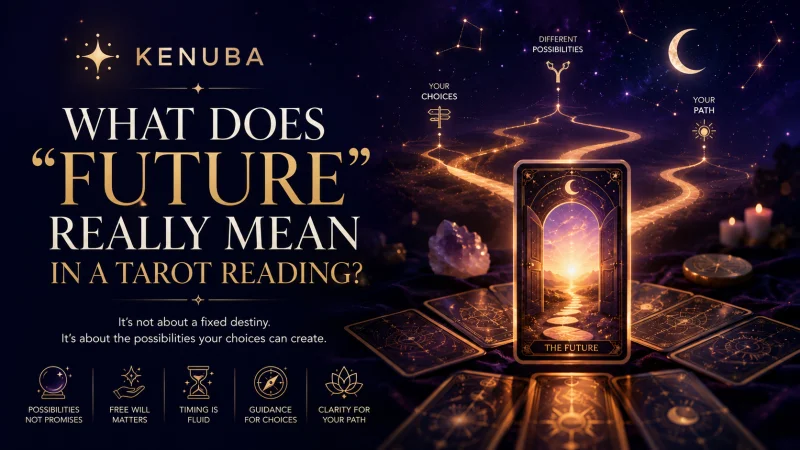
What Does “Future” Really Mean in a Tarot Reading?
When someone books a tarot reading, one of the first questions they may ask is:
“What is going to happen in my future?”
It is a natural question.
When you're uncertain about love, career, money, family, or an important decision, knowing what comes next can feel comforting. You may want to know whether someone will return, whether a relationship has a future, whether your career will improve, or whether you're finally moving toward the life you want.
But there is an important distinction to understand.
A tarot reading does not have to mean that your future is permanently written in stone.
In many spiritual traditions, tarot is used as a tool for reflection, intuition, perspective, and exploring possible paths. A future-focused reading can help you think about where your current choices and circumstances may be leading.
That makes the word “future” more interesting than it first appears.
The future in a tarot reading can represent a potential direction, not necessarily an unavoidable outcome.
🔮 Quick Answer: What Does “Future” Mean in Tarot?
In a tarot reading, “future” generally refers to a possible outcome or direction based on the circumstances, choices, emotions, and patterns surrounding a question at the time of the reading.
It does not necessarily mean a guaranteed event will happen exactly as shown.
Your decisions can change circumstances.
Other people's choices can change circumstances.
New information can change circumstances.
Even your own priorities may change.
So rather than asking only:
“What will happen?”
a more useful question can be:
“Where might this situation be heading, and what can I learn from it?”
This approach allows tarot to become a tool for insight rather than a replacement for your own judgment.
Does Tarot Predict the Future?
This is one of the most common questions about tarot.
The answer depends partly on how you approach tarot.
Some people use tarot as a form of divination and believe cards can provide insight into future possibilities. Others approach tarot more psychologically or spiritually, using the cards to explore emotions, patterns, decisions, and potential outcomes.
For a trustworthy approach, it is helpful to avoid treating a reading as an absolute guarantee.
For example, imagine someone asks:
“Will I get back together with my ex?”
A future-focused tarot reading might explore the emotional energy surrounding the relationship, unresolved issues, possible developments, and choices available to the person.
That is different from saying:
“You will definitely get back together on a specific date.”
The first approach leaves room for personal agency.
The second presents an uncertain future as a certainty.
At Kenuba, spiritual guidance should encourage reflection and clarity rather than remove your ability to make your own choices.
Why the Future Is Not Always Fixed
Think about your life one year ago.
You probably had plans, expectations, worries, and ideas about where you would be today.
Some happened.
Others didn't.
Some changed because of your choices.
Others changed because circumstances outside your control shifted.
This is one reason the idea of a completely fixed future can be difficult to apply to everyday life.
A tarot reading takes place at a particular moment.
Your situation at that moment includes your current thoughts, emotions, relationships, choices, and circumstances.
As those things change, the possible paths ahead can change too.
For example:
You ask a tarot reader about your career.
The reading suggests that continuing your current path could lead toward greater responsibility.
A month later, you receive a completely unexpected opportunity in another field.
You choose to accept it.
Your future has now changed because your choice changed the path.
This is why future-oriented tarot can be more useful when viewed as a conversation about possibilities rather than guarantees.
Tarot and Free Will
The concept of free will is important when discussing future tarot readings.
A reading may highlight a possible direction, but you still make decisions.
You decide whether to communicate.
You decide whether to leave.
You decide whether to apply for the job.
You decide whether to continue pursuing a goal.
You decide how to respond to a difficult situation.
Tarot can encourage you to consider these choices from another perspective.
Instead of asking:
“Will this happen?”
Try asking:
“What can I do to create the best possible outcome?”
This small change can completely transform the purpose of a reading.
You move from waiting for fate to taking part in your own life.
What Future Tarot Cards May Actually Show
A future position in a tarot spread can represent several different things.
Depending on the reader and the question, it may explore:
- A possible outcome
- A developing pattern
- The direction of a situation
- An opportunity
- A challenge
- An emotional development
- A consequence of current choices
- Something you may need to consider
- A potential lesson
- An area where change may occur
The meaning also depends on the surrounding cards.
For example, The Chariot might be interpreted as movement, determination, or taking control of direction.
The Hermit may encourage reflection, solitude, or stepping back before moving forward.
The Wheel of Fortune is often associated with change, cycles, and shifting circumstances.
However, individual card meanings should not be treated as universal predictions.
The same card can have different meanings depending on the question, spread, surrounding cards, and reader's interpretation.
How Tarot Timing Works
One of the most popular questions people ask is:
“When will it happen?”
This is where tarot becomes particularly interesting.
Some tarot traditions associate certain cards, suits, numbers, or astrological correspondences with timing.
However, tarot timing is not always precise.
A card might suggest movement or delay without giving an exact calendar date.
For example, The Hanged Man may traditionally be associated with waiting, suspension, or seeing a situation differently.
The Chariot may suggest movement or forward momentum.
But interpreting either card as a guaranteed event on a specific date would go beyond what the card itself can establish.
A better approach to timing
Instead of asking:
“Exactly when will this happen?”
you might ask:
- What needs to happen first?
- What could speed this situation up?
- What could delay it?
- What signs of progress should I pay attention to?
- What can I do while I wait?
- What is within my control?
These questions often produce more practical insight.
Why Timing in Tarot Can Be Difficult
Life does not always operate according to a simple schedule.
Relationships involve two people.
Career changes depend on opportunities and decisions.
Financial situations depend on many external factors.
Personal growth can happen gradually.
Because of this, a tarot reading may provide a sense of direction without providing an exact timetable.
A responsible reader should be comfortable acknowledging uncertainty.
A reading can still be valuable even when the answer isn't:
“Tuesday at 3 PM.”
Sometimes the most meaningful insight is understanding what needs to change before the next chapter can begin.
Tarot and Relationships
Love and relationships are among the most common reasons people seek tarot readings.
You might ask:
“Does this relationship have a future?”
“Why has someone become distant?”
“Should I reach out?”
“What can I learn from this breakup?”
A future-focused tarot reading can help you explore the situation from different angles.
For example, instead of trying to guarantee whether someone will return, a reading might help you reflect on:
- The current relationship dynamic
- Unresolved emotions
- Communication patterns
- Your own expectations
- Possible challenges
- What you can control
- What you may need to release
- Potential directions
This can be particularly helpful when emotions make it difficult to see a situation clearly.
Remember:
Another person's choices cannot be controlled through a tarot reading.
A healthy relationship ultimately depends on communication, consent, mutual effort, respect, and real-world behavior.
Tarot and Career Decisions
Future tarot readings aren't only about relationships.
Many people use tarot to reflect on career questions.
You might be considering:
- Changing jobs
- Starting a business
- Returning to education
- Accepting a new opportunity
- Leaving an unhealthy workplace
- Developing a new skill
- Pursuing a creative project
A tarot reading can provide a different perspective on your concerns.
For example, you might ask:
“What should I consider before accepting this opportunity?”
That can be more useful than simply asking:
“Will this job make me successful?”
The first question encourages reflection.
The second can make you feel as though the cards must provide a definitive yes or no.
Tarot and Personal Growth
Perhaps one of the most valuable uses of future-oriented tarot is personal growth.
Sometimes the future question is really an emotional question underneath.
You may ask:
“Will I find love?”
But underneath that question could be:
“Am I ready to trust someone again?”
You may ask:
“Will my career improve?”
But underneath it could be:
“Do I believe I am capable of more?”
You may ask:
“Will my ex come back?”
But underneath it could be:
“How do I finally move forward?”
Tarot can create a space where these deeper questions become easier to explore.
Past, Present, and Future Tarot Spreads
The classic past-present-future spread is one of the simplest ways to explore a situation.
🕰️ Past
This position may represent experiences, influences, or patterns that shaped the current situation.
🌿 Present
This position focuses on the current circumstances, emotions, or energy surrounding the question.
🔮 Future
This position can explore a potential direction or outcome if current circumstances continue.
The future card shouldn't necessarily be interpreted as an unavoidable event.
Instead, consider it a question:
“If nothing significantly changes, where might this situation be heading?”
That perspective makes the reading more practical.
What If a Tarot Prediction Does Not Happen?
This is an important question.
Suppose a reading suggests a particular outcome, but your life takes a different direction.
Does that mean the reading was useless?
Not necessarily—but it is important not to force an interpretation after the fact.
A future reading represents an interpretation at a particular moment.
Circumstances may change.
You may make a different choice.
Another person may make a different choice.
New information may appear.
Your priorities may change.
Instead of trying to make reality fit the reading, ask:
“What has changed since the reading?”
That question keeps the focus on your real life rather than on proving the cards right.
Common Mistakes When Asking About the Future
1. Treating tarot as an absolute guarantee
A reading should not replace your own judgment.
2. Asking the same question repeatedly
Repeated readings can create confusion instead of clarity.
3. Making major decisions based only on a reading
Important decisions often require practical information, professional advice, research, and careful consideration.
4. Looking for only the answer you want
Sometimes we interpret signs differently when we're emotionally attached to an outcome.
5. Ignoring real-world behavior
In relationships especially, actions and communication matter.
6. Becoming dependent on readings
Spiritual guidance should support your ability to make decisions—not take that ability away.
When You Should Rely on Practical Information Instead
Tarot should not replace qualified professional advice when a situation requires it.
For example, medical, legal, financial, or safety-related decisions may require professionals with appropriate expertise.
Likewise, if you're making a major career decision, research the opportunity.
If you're considering a relationship, pay attention to communication and behavior.
If you're dealing with financial choices, review the actual numbers.
Spiritual reflection and practical decision-making can coexist.
You don't have to choose one over the other.
Tarot, Intuition, and Personal Reflection
Tarot can be viewed as a conversation between symbols and your own perspective.
A card may remind you of something you've been avoiding.
Another may help you see a situation from a different angle.
A difficult card may encourage you to ask a question you didn't want to consider.
A positive card may remind you of strengths you've forgotten.
This is where intuition can become important.
Instead of asking:
“Does this card guarantee my future?”
consider asking:
“What does this card make me notice about my current life?”
That shift can make a tarot reading much more personal and meaningful.
🔮 Is Your Future Already Written?
This may be the biggest question behind every future tarot reading.
There is no need to think of your future as a single road with only one destination.
Imagine instead that your life contains many possible paths.
Your choices create movement.
Circumstances create changes.
Other people make their own decisions.
Unexpected opportunities appear.
You learn.
You grow.
You change your priorities.
A tarot reading can help you pause and look at the road you're currently traveling.
But you are still living the journey.
Connect With a Kenuba Psychic Advisor
If you're wondering about your future, you don't have to approach the question as simply “What will happen?”
You can explore something deeper:
“What direction am I moving toward?”
“What choices are shaping my future?”
“What should I understand about this situation?”
“What can I do to create a healthier path forward?”
At Kenuba, you can connect with advisors who offer spiritual guidance for questions about relationships, personal growth, life direction, and other areas of your journey.
🔮 Connect with an experienced Kenuba psychic advisor and explore your questions through a personalized reading.
A reading can offer perspective.
Your choices create your path.
Conclusion: The Future Is More Than a Prediction
When people ask what the future means in a tarot reading, they're often looking for certainty.
They want to know what will happen, when it will happen, and whether everything will work out.
But uncertainty is part of being human.
A future tarot reading can offer another way to look at that uncertainty.
Instead of treating the cards as an unchangeable script, you can use them to explore possible directions, emotional patterns, choices, and opportunities.
The future card is not necessarily telling you:
“This is what must happen.”
It may be inviting you to consider:
“If you continue on this path, where could it lead?”
And that is a much more empowering question.
Because the future isn't only something you wait for.
It's something you participate in creating. 🔮✨
Frequently Asked Questions
1. What does “future” mean in a tarot reading?
“Future” usually refers to a potential direction, development, or outcome connected to the circumstances surrounding your question. It does not necessarily mean a guaranteed event. Your decisions, changing circumstances, and other people's choices can influence what happens. A future tarot reading can therefore be approached as a way to explore possibilities and gain perspective.
2. Can tarot really predict the future?
People have different beliefs about tarot and prediction. Some view tarot as divination, while others use it primarily for reflection and spiritual guidance. A responsible approach avoids presenting uncertain future events as guaranteed facts. Tarot can be used to explore possible paths, patterns, emotions, and choices without assuming that every outcome is permanently predetermined.
3. Does tarot show one fixed future?
Not necessarily. Many tarot readers view future cards as showing a potential outcome based on current circumstances. Choices can change circumstances and therefore change the direction of a situation. This is particularly important when reading about relationships, careers, and major life decisions.
4. Can I change what a tarot reading says?
Your choices can influence future circumstances. A tarot reading provides an interpretation of a situation at a particular moment. If you make different decisions or circumstances change, the potential outcome can change as well. This is one reason many people find the idea of tarot and free will compatible.
5. How far into the future can tarot predict?
There is no universally reliable time limit for tarot. Some readings focus on the coming weeks or months, while others explore a broader future direction. Timing can be difficult to interpret precisely, so it is often more useful to ask what developments or conditions may influence the situation.