



Can Tarot and Pendulum Readings Give Different Answers?
Need Guidance On Your Problems?
Consult With The Best Online Psychics


Can Tarot and Pendulum Readings Give Different Answers?
You ask a tarot reader:
“Is this relationship moving toward something meaningful?”
The cards suggest yes.
Later, you use a pendulum and receive no.
Now you're confused.
Which answer should you believe?
Did one reading get it wrong?
Or could both readings be showing something different?
If you've ever experienced this, you're not alone.
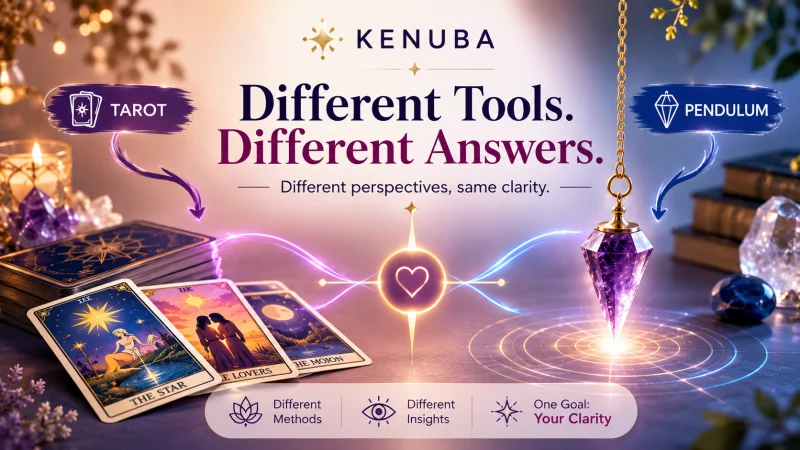
Tarot and pendulum readings are two different spiritual tools. They can approach a question from very different angles.
A pendulum is often used for focused questions, particularly yes-or-no questions.
Tarot works through cards, symbolism, spreads, and interpretation. It can explore emotions, patterns, challenges, possibilities, and different aspects of a situation.
Because the methods are different, their answers may not always look identical.
That doesn't automatically mean something has gone wrong.
The more useful question may be:
“What is each reading helping me explore?”
Let's take a closer look.
Quick Answer: Can Tarot and Pendulum Readings Give Different Answers?
Yes. Tarot and pendulum readings can produce different answers or interpretations because they use different methods, question formats, and approaches to spiritual reflection.
A pendulum is often used for focused yes-or-no questions.
Tarot generally provides a more symbolic and layered interpretation.
For example:
Pendulum:
“Is contacting this person right now beneficial for me?”
Tarot:
“What should I understand about my connection with this person?”
These questions may relate to the same situation but are not actually asking the same thing.
Even when the question is identical, the reading may be interpreted differently.
That's why a different answer doesn't necessarily mean that one tool has “failed.”
Tarot and Pendulum: What's the Difference?
Before comparing their answers, it helps to understand what makes the two tools different.
Tarot Reading
Tarot uses a deck of cards containing symbolic imagery and traditional meanings.
A reading can involve:
- Major Arcana
- Minor Arcana
- different tarot spreads
- card combinations
- upright and reversed interpretations
- the reader's intuitive interpretation
- the question being asked
- the context provided by the person receiving the reading
Tarot is often useful when someone wants to explore the bigger picture.
For example:
“What should I understand about this relationship?”
This gives the reader more room to explore the situation.
Pendulum Reading
A pendulum is generally used differently.
The practitioner establishes specific movements to represent responses such as:
- yes
- no
- unclear
- maybe
- not now
The exact system can vary between practitioners.
Pendulum readings are therefore often attractive when someone wants a direct and focused question.
For example:
“Would contacting this person right now be beneficial for me?”
Community discussions around tarot and pendulum practices frequently describe pendulums as particularly convenient for yes/no questions, while tarot tends to offer more context.
Neither approach has to be treated as universally better.
They simply provide different formats for spiritual reflection.
Why Might Tarot and Pendulum Give Different Answers?
There are several possible reasons.
1. The Questions May Not Actually Be Identical
This is one of the most common reasons.
Imagine you ask tarot:
“What is the potential of this relationship?”
Then ask your pendulum:
“Should I contact this person today?”
These aren't the same question.
The tarot reading could explore the overall relationship.
The pendulum could be responding to the immediate decision.
The answers may appear contradictory when they're actually addressing different things.
Try This Instead
Write your question down before starting the reading.
For example:
“Is contacting this person today likely to support my emotional wellbeing?”
Then use the same wording if you compare tools.
This creates a much clearer comparison.
2. Tarot May Explore the “Why,” While a Pendulum Focuses on the “Yes or No”
This is one of the biggest practical differences.
A pendulum can give you:
Yes.
Or:
No.
Tarot can potentially give you:
Yes, but here's the challenge.
Or:
The connection has potential, but there are unresolved emotional patterns.
That's why a tarot reading may seem more complicated.
The cards aren't necessarily contradicting a pendulum.
They may simply be adding context.
One current tarot discussion describes this distinction well: practitioners often prefer a pendulum for a direct yes/no question, while tarot is useful when the person wants to explore the reasons or context behind an answer.
3. Timing Can Change the Reading
Relationships and life situations don't remain frozen.
A reading you receive today reflects a different moment from a reading you receive three weeks later.
During that time:
- someone may contact you
- communication may improve
- a relationship may end
- your feelings may change
- you may discover new information
- your priorities may shift
- another person may make a different choice
This is particularly important with future-focused questions.
A reading should not be treated as an unchangeable guarantee.
Instead, consider it within the context of the moment in which it was received.
4. Your Question May Be Too Complicated
Consider this question:
“Will my ex come back, apologize, ask me to marry them, and will we have a happy relationship?”
That's actually several questions.
A tarot deck may highlight one part.
A pendulum may respond to another.
Instead, break the situation down.
Question 1
Is reconciliation currently possible?
Question 2
Would reconnecting be healthy for me?
Question 3
Is there unresolved communication between us?
Question 4
Would giving the situation more time benefit me?
Now your questions become much easier to explore.
5. Different Readers May Interpret the Same Situation Differently
Two tarot readers may draw the same card and emphasize different meanings.
One might focus on:
emotional healing.
Another might focus on:
relationship potential.
Neither interpretation necessarily means the reader is deliberately giving incorrect information.
Tarot involves interpretation.
The reader's experience, reading style, question, spread, and surrounding context can influence the way the cards are discussed.
The same principle applies to spiritual tools more broadly.
6. Your Emotional State Can Influence How You Understand a Reading
This is especially important with relationship questions.
Imagine you're deeply worried that someone will leave you.
You receive a complicated tarot reading.
You may focus only on the card that gives you hope.
Or perhaps you receive a difficult card and interpret it as proof that everything is ending.
The emotional meaning you attach to the reading can become stronger than the reading itself.
That's why it can help to pause.
Ask yourself:
“Am I looking for insight, or am I looking for reassurance?”
Those are very different goals.
7. The Tools May Be Answering Different Layers of the Situation
Imagine your question is:
“Should I contact my ex?”
A pendulum might provide:
No.
A tarot reading might show:
- unresolved feelings
- emotional attachment
- communication problems
- a need for healing
- potential future communication
Does that mean the tarot says yes?
Not necessarily.
The tarot may be explaining why waiting could be important.
The pendulum may simply have answered the immediate question.
This is why a seemingly contradictory reading can sometimes become more understandable when you look at the bigger picture.
What If Tarot Says Yes and the Pendulum Says No?
Don't panic.
First, look at the exact wording.
Suppose tarot was asked:
“Does this relationship have potential?”
And the pendulum was asked:
“Should I contact them today?”
The answers could be:
Tarot: Yes, there is potential.
Pendulum: No, don't contact them today.
Those answers aren't necessarily contradictory.
A relationship can have potential while the timing for communication is still poor.
What If Tarot Says No and the Pendulum Says Yes?
The same principle applies.
Imagine:
Tarot:
“This connection has significant challenges.”
Pendulum:
“Would communicating honestly help me?”
Yes.
Again, these aren't necessarily opposing answers.
The relationship may be challenging while an honest conversation could still be valuable.
The key is to examine what each answer actually refers to.
Should You Trust Tarot or Pendulum More?
There isn't one universal answer.
It depends on the question.
Choose a Pendulum-Style Reading When:
You want to explore a simple, focused question.
For example:
- Would waiting benefit me?
- Is now a good time to talk?
- Should I explore this opportunity?
- Would taking some space help?
Choose Tarot When:
You want to explore:
- emotions
- relationship patterns
- challenges
- motivations
- possibilities
- personal growth
- broader context
- different paths
Consider Both When:
You want both:
a focused question + deeper context.
For example:
Pendulum
“Would reaching out right now benefit me?”
Tarot
“What should I understand about this situation before deciding?”
That can create a more complete reflection.
A Better Way to Handle Conflicting Readings
Try this five-step approach.
Step 1: Stop
Don't immediately book another reading.
Take some time.
Step 2: Compare the Questions
Were the exact questions identical?
If not, the answers may not actually conflict.
Step 3: Compare the Timing
Did something change between the readings?
If yes, the new reading may reflect a different situation.
Step 4: Look for the Theme
Instead of focusing only on “yes” or “no,” look for recurring themes.
Maybe both readings point toward:
- patience
- communication
- healing
- boundaries
- personal growth
- uncertainty
That common theme may be more useful than the individual answer.
Step 5: Return to Reality
Look at the actual situation.
What is happening in your relationship?
What has the person said?
What have their actions shown?
What do you need?
Tarot and Pendulum Readings for Relationship Questions
Relationship questions are especially sensitive because emotions can be intense.
You might ask:
“Does my partner love me?”
But a more useful question may be:
“What should I understand about the current dynamic between us?”
Instead of:
“Will my ex return?”
Try:
“What do I need to understand before considering reconciliation?”
Instead of:
“Is this my soulmate?”
Try:
“Does this relationship support the kind of partnership I want?”
These questions move the focus away from trying to control another person's choices.
They also give you more useful information to reflect on.
Can Tarot and Pendulum Readings Predict the Future?
Spiritual traditions often use tarot and pendulums to explore possible outcomes or guidance.
However, future events are influenced by choices, circumstances, timing, and other people's decisions.
That's why it's healthier to view readings as reflection and guidance rather than guaranteed predictions.
A positive tarot reading doesn't guarantee that a relationship will last forever.
A negative reading doesn't mean your future is permanently decided.
Likewise, a pendulum's “yes” or “no” shouldn't remove your ability to make your own choices.
When a Psychic Advisor Can Help
Sometimes the problem isn't that you need another prediction.
You may simply need someone to help you organize the situation.
An experienced psychic advisor can listen to the context behind your question and help you explore it through their chosen reading style.
For example:
“My ex has contacted me after six months. I still have feelings, but I'm afraid of repeating the same problems.”
That's a very different situation from:
“Will my ex return?”
The first question contains context.
A conversation with an advisor can allow you to explore that context more deeply.
Kenuba's advisor marketplace includes different reading specialties, including tarot and pendulum-related guidance, allowing users to explore advisors based on their preferred approach.
🔮 Explore your relationship & spiritual questions with a Kenuba advisor:
Final Conclusion
So, can tarot and pendulum readings give different answers?
Absolutely.
But a different answer doesn't necessarily mean that something has gone wrong.
Tarot and pendulum readings are different spiritual practices.
One may offer a broader symbolic perspective.
The other may offer a focused yes-or-no response.
One may explore the why.
The other may help you focus on the question you're asking right now.
And sometimes, the difference between the two can encourage you to look deeper.
Instead of asking:
“Which one is right?”
try asking:
“What can I learn from each perspective?”
If both readings point toward patience, communication, healing, or personal growth, that shared theme may be more meaningful than whether one tool says yes and another says no.
And if they genuinely seem to disagree, you don't have to immediately choose one.
Pause.
Review the question.
Look at the circumstances.
Think about what has changed.
Listen to your intuition.
And most importantly, pay attention to what is happening in real life.
Spiritual guidance can provide perspective.
It shouldn't take away your ability to make your own choices.
If you'd like to explore a tarot or pendulum question with an experienced advisor, you can browse Kenuba's available advisors and choose a reading style that feels right for you.
🔮 Explore your relationship & spiritual questions with a Kenuba advisor:
FAQ
1. Can tarot and pendulum readings give different answers?
Yes. The two tools use different methods, and readings may focus on different aspects of the same situation. A pendulum is often used for focused yes-or-no questions, while tarot can explore broader themes and symbolism. Timing and question wording can also affect the reading.
2. What should I do if my tarot reading and pendulum disagree?
Don't immediately assume that one is wrong. Compare the questions, timing, and context. Look for common themes rather than focusing only on yes or no. You may discover that one reading is addressing the immediate decision while another is exploring the larger situation.
3. Is tarot better than a pendulum?
Neither is automatically better. Tarot is often preferred for detailed exploration, while pendulums are commonly used for simple yes-or-no questions. The better option depends on what you want to understand.
4. Is a pendulum good for yes-or-no questions?
A pendulum is commonly used in spiritual practices for focused yes-or-no questions. The exact meaning assigned to different movements depends on the practitioner's method. It should be approached as a spiritual reflection tool rather than a guaranteed source of factual information.
5. Can tarot answer yes-or-no questions?
Some tarot practitioners use their own methods for yes-or-no questions, but tarot is often better suited to questions that allow room for interpretation and context. Instead of asking only “yes or no,” many readers prefer questions about what you should understand, what may be influencing a situation, or what choices are available.