


AI Tarot vs Human Tarot Readings: What Feels Different?
Need Guidance On Your Problems?
Consult With The Best Online Psychics


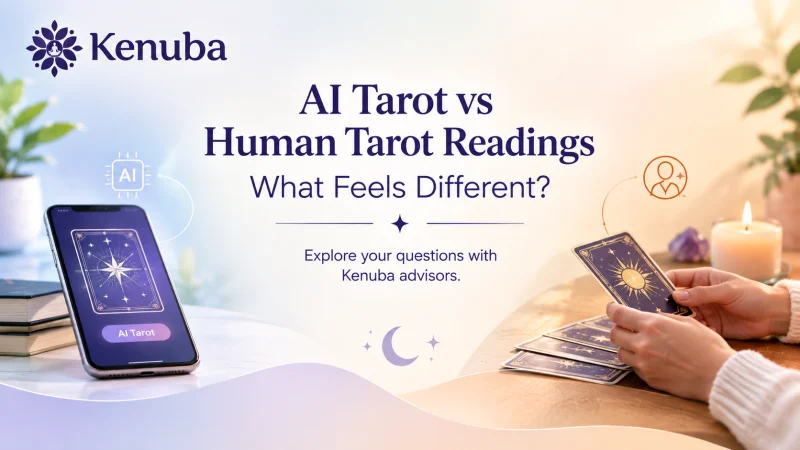
AI Tarot vs Human Tarot Readings: What Feels Different?
Imagine asking a tarot question late at night.
You open an AI tool, type your question, and within seconds you receive an interpretation.
Another time, you sit with a human tarot reader. You explain your situation, discuss your question, and the reader asks you something you had not considered before.
Both experiences involve tarot cards.
But they can feel very different.
As AI becomes increasingly common in spiritual and reflective practices, people are beginning to explore AI-generated tarot readings alongside traditional readings with human readers. Recent research and reporting in 2026 have found that tarot practitioners are already experimenting with AI for interpreting cards, exploring alternative perspectives, and reflecting on their own readings.
So what actually changes when you move from an AI tarot reading to a human tarot reading?
The answer is not simply about which one is "better."
It is about the type of experience, interpretation, conversation, and reflection you are looking for.
What Is an AI Tarot Reading?
An AI tarot reading uses artificial intelligence to generate an interpretation based on tarot cards, your question, and the information you provide.
Depending on the tool, you may be able to:
- Ask a question about love or relationships
- Explore career-related questions
- Receive explanations of individual tarot cards
- Generate a multi-card interpretation
- Compare different interpretations
- Use tarot as a journaling or reflection exercise
- Explore traditional meanings of the cards
AI can process a large amount of written information quickly and organize it into a readable response.
For someone learning tarot, this can make it easier to explore card symbolism or see how different cards might relate to a particular question.
However, an AI system only has access to the information available through the interaction. It does not automatically know the details you have not shared.
That distinction becomes important when a tarot question is emotionally complicated.
What Is a Human Tarot Reading?
A human tarot reading involves a person interpreting the cards in conversation with you.
The reader may consider:
- Your question
- The cards that appear
- The position of each card
- The relationship between multiple cards
- The context you provide
- Follow-up questions
- Your reactions during the conversation
- Different possible interpretations
Tarot is highly dependent on context.
For example, the same card can be interpreted differently depending on the question, surrounding cards, and circumstances. Recent discussions about AI and tarot have highlighted this issue: tarot practitioners may use the same card in very different ways depending on the situation being explored.
A human reading therefore becomes more than simply asking, "What does this card mean?"
It becomes a conversation about what the card might mean in your particular situation.
AI Tarot vs Human Tarot: The Biggest Difference
The most noticeable difference is often interaction.
With AI, you usually type a question and receive an answer.
With a human reader, there can be an ongoing conversation.
You might say:
"That part doesn't really connect with me."
A human reader can ask:
"What part doesn't feel right?"
That response can lead the reading in a completely different direction.
Similarly, you might mention an important detail halfway through a session that changes how the cards are interpreted.
AI can respond to information you provide, but a human reading naturally develops through conversation.
This can make the experience feel more personal and dynamic.
AI Tarot Can Feel Fast and Convenient
One of the biggest differences is convenience.
AI tarot can be available almost immediately.
You don't necessarily need to:
- Schedule an appointment
- Wait for a session
- Prepare a long explanation
- Talk to another person
- Share your situation verbally
You can simply type.
For someone who wants to explore a tarot card, organize their thoughts, or reflect on a question privately, that accessibility can be useful.
Recent comparisons of AI and human tarot readings have similarly identified speed, availability, and privacy as important characteristics of AI-based readings.
Human Tarot Can Feel More Conversational
A human reading can unfold naturally.
You may start with one question and discover that the real question is something else.
For example:
"Will this relationship work?"
might eventually become:
"Why am I afraid to let this relationship change?"
That shift can be meaningful.
A human reader can ask questions, listen to your answers, and explore the reading with you.
This does not mean every human reader will interpret cards in exactly the same way. Human readers have their own experience, methods, perspectives, and limitations.
But the interaction itself is different.
AI Can Help You Explore Multiple Interpretations
One interesting use of AI is exploring different possibilities.
Suppose you pull The Tower in a tarot reading.
Instead of assuming that it automatically means something negative, you could ask an AI system to explain several traditional interpretations.
The Tower might be explored through themes such as:
- Sudden change
- Challenging assumptions
- Unexpected disruption
- Revealing something previously hidden
- Letting go of an unstable foundation
- Transformation after a difficult realization
This can encourage you to look beyond a single interpretation.
Research into tarot practitioners' use of AI has found that some readers use AI specifically to generate alternative perspectives or challenge their own assumptions about a reading.
Human Readers Can Add Personal Context
A human reader can potentially notice that your question has more emotional depth than the words themselves suggest.
For example, you might ask:
"Should I contact my ex?"
But during a conversation, it may become clear that the real concern is loneliness, unfinished feelings, uncertainty, or a desire for closure.
The cards are still the cards.
But the conversation surrounding them can change how you reflect on their symbolism.
This is one reason some people experience a human reading as more personal.
What About Intuition?
This is where the comparison becomes particularly interesting.
Many tarot readers describe their practice as involving more than memorizing card meanings. They may develop personal associations, notice patterns, or experience intuitive impressions while working with a particular person.
AI works differently.
It generates responses based on patterns in language and the information available to it.
It can explain symbolism and produce different interpretations, but that does not establish that AI possesses human intuition or spiritual perception.
Some 2026 discussions of AI tarot specifically point to this difference between algorithmic interpretation and the lived experience that human readers bring to a reading.
For people who value the intuitive and relational aspects of tarot, this distinction may be an important part of the experience.
Can AI Tarot Be Personalized?
Yes, to an extent.
The more context you provide, the more specifically an AI system can respond to your question.
For example, compare:
"What does The Moon mean?"
with:
"I pulled The Moon in a relationship reading because I'm uncertain whether I should trust what I'm feeling. What are some reflective ways to understand this card?"
The second question provides significantly more context.
AI can use that information to produce a more targeted response.
But there is an important limitation:
AI only knows what you provide.
It cannot independently verify another person's private feelings, hidden intentions, or future actions.
That is why tarot readings are better approached as tools for reflection rather than guaranteed answers about what will happen.
Can a Human Tarot Reader Be Wrong?
Absolutely.
Choosing a human reader does not automatically guarantee accuracy.
Human readers can have:
- Personal biases
- Different levels of experience
- Different interpretations
- Different reading styles
- Different assumptions
A confident-sounding interpretation is not necessarily a certain one.
The same applies to AI.
An AI-generated answer can sound extremely confident even when several interpretations are possible. This has been identified as a concern in recent discussions of AI-assisted tarot because tarot often depends on ambiguity and context.
A responsible approach is to treat a reading as something to consider, rather than something that removes your ability to choose.
AI Tarot and Human Tarot Can Serve Different Purposes
Instead of viewing them as competitors, you can think of them as different experiences.
AI Tarot may be useful for:
- Learning tarot card meanings
- Exploring symbolism
- Getting a quick written interpretation
- Journaling
- Generating reflective questions
- Comparing possible interpretations
- Private exploration
Human Tarot readings may be useful for:
- Having a conversation about a complex question
- Exploring personal context
- Asking follow-up questions
- Discussing emotional reactions
- Receiving a personalized reading experience
- Exploring multiple interpretations interactively
Neither format has to replace the other.
In fact, some tarot practitioners have reported using AI alongside their own tarot practice to challenge assumptions or consider interpretations they may not have noticed themselves.
What Feels Different During a Human Reading?
For many people, the biggest difference isn't the card.
It is the human connection around the card.
A human tarot session can include pauses, questions, reactions, clarification, storytelling, and conversation.
You can say:
"I don't understand that."
"That reminds me of something that happened last year."
"Actually, I think this card connects to something completely different."
The reader can then respond.
That back-and-forth creates an experience that is different from receiving a generated response on a screen.
What Feels Different About AI Tarot?
AI can create a different kind of experience.
It can feel:
Immediate.
Private.
Structured.
Easy to revisit.
You can return to the same written interpretation later and examine it from another perspective.
For people who enjoy independent reflection, that can be valuable.
At the same time, AI responses should not automatically be treated as objective truth simply because they are generated by technology.
AI can produce persuasive language without actually knowing whether its interpretation applies to your life.
Should You Try AI Tarot or a Human Tarot Reading?
That depends on what you want from the experience.
If you're curious about a tarot card, learning symbolism, or looking for a quick reflective exercise, AI can be an accessible place to start.
If you want a conversation where someone can listen to your situation, ask follow-up questions, and explore the cards with you, a human tarot reading offers a different experience.
You can also use both.
For example:
- Pull your own cards.
- Write down your first impression.
- Explore traditional meanings.
- Use AI to generate alternative interpretations.
- Speak with a human reader if you want a deeper conversation.
- Compare the different perspectives.
- Decide what, if anything, feels meaningful to you.
The important part is keeping your own judgment and free will at the center.
Tarot Is Still About Reflection
Whether you use AI, a physical deck, or a human tarot reader, a tarot reading doesn't have to provide a definite prediction.
Sometimes the most useful question isn't:
"What will happen?"
It may be:
"What am I not seeing clearly?"
Or:
"What am I afraid to acknowledge?"
Or:
"What possibility should I explore?"
That shift can make tarot a more reflective experience.
AI can help you explore language and symbolism.
A human reader can help you explore those symbols through conversation.
And ultimately, you decide what meaning the experience has for you.
Final Thoughts
AI is changing the way people interact with tarot.
It can make card meanings easier to explore, provide instant interpretations, and offer alternative perspectives. Human tarot readings bring a different dimension through conversation, personal context, experience, and the relationship between reader and seeker.
Neither experience needs to be treated as a guaranteed window into the future.
Instead, consider what you are looking for.
Do you want a quick interpretation?
A private reflection?
A way to learn tarot?
Or a conversation about a personal situation?
The answer may determine which type of tarot experience feels most meaningful to you.
And sometimes, the most valuable tarot reading isn't the one that gives you a definite answer.
It is the one that helps you ask a better question.
🔮 Explore a Personal Tarot Reading with Kenuba
If you're looking for a human perspective on your tarot questions, you can explore Kenuba's advisors and find a reader for your personal situation.
Join now and take advice from our top expert advisors.